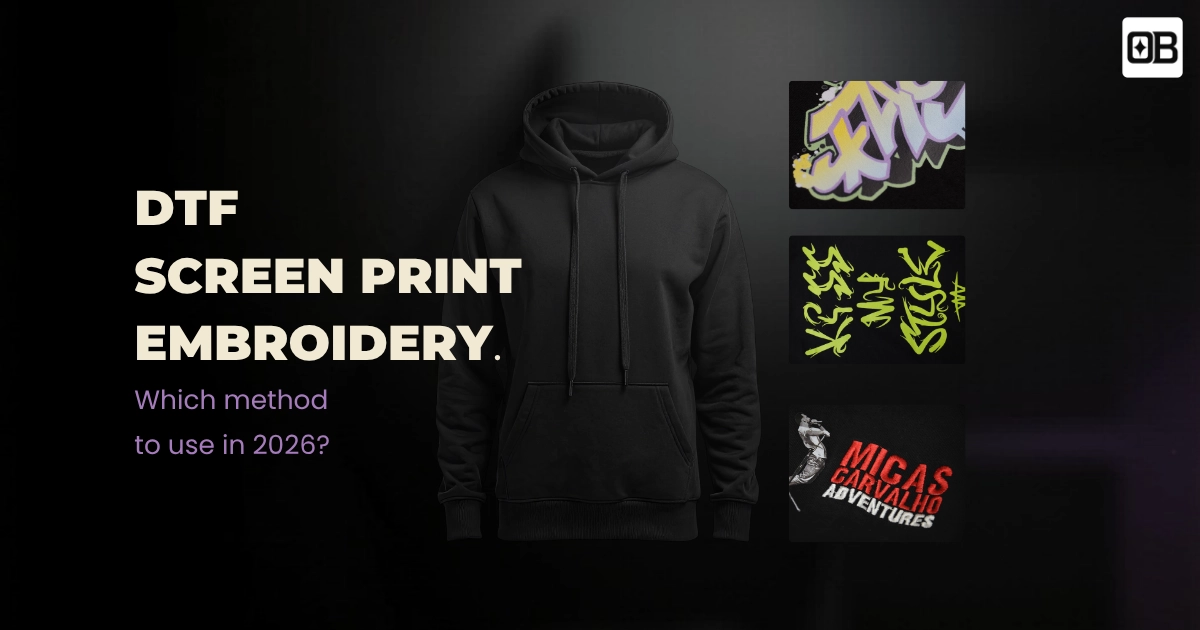
DTF vs screen printing is one of the most debated production decisions in the garment industry — and for good reason. The decoration technique you choose directly impacts your production costs, minimum order quantities, design possibilities, and the perceived quality of your finished product.
Understanding DTF vs screen printing (and where embroidery fits in the picture) is not just a technical exercise. It is a branding and business strategy decision that affects your margins, your timelines, and how customers perceive your clothing brand from the very first touch.
This complete guide breaks down DTF vs screen printing vs embroidery across every dimension that matters to a clothing brand founder.
Why DTF vs Screen Printing Matters for Your Brand
The DTF vs screen printing decision is more than a production technicality — it is a positioning choice. Your decoration technique signals quality, price point, and attention to detail to every customer who picks up your garment.
According to Printful’s DTF printing guide, DTF technology has evolved dramatically since 2021, delivering results that rival traditional methods for small-batch and on-demand production. Yet screen printing remains the gold standard for volume, color vibrancy, and durability.
Understanding DTF vs screen printing strategically allows you to match your production technique to your brand stage, design complexity, and target margins — and avoid costly mistakes on your first production run.
DTF vs Screen Printing: Exact Definitions
Before diving into the full DTF vs screen printing comparison, let us define both techniques clearly.
DTF — Direct to Film
DTF (Direct to Film) is a modern printing method where your design is printed onto a special polyurethane film, then heat-transferred directly onto the garment. DTF handles unlimited colors, photographic detail, and fine gradients with zero setup fees. It works on virtually any fabric — cotton, polyester, blends, nylon — making it the most versatile technique in the DTF vs screen printing comparison.
Screen Printing
Screen printing is the traditional garment decoration method where each color requires a separate physical screen (stencil). Ink is pressed through the screen directly onto the fabric. Screen printing delivers exceptional color saturation and long-term durability — but setup costs are significant, and the technique becomes economical only at volumes of 100+ pieces per run.
In DTF vs screen printing, screen printing wins on cost efficiency at high volumes and on long-term ink durability.
Embroidery
Embroidery uses thread stitched directly into the fabric by a digitally programmed machine. In the DTF vs screen printing vs embroidery comparison, embroidery is the highest-perceived-value technique — communicating premium quality, tactile richness, and lasting craftsmanship. It is the preferred method for chest logos, cap branding, and workwear.
DTF vs Screen Printing vs Embroidery: Full Comparison Table
| Feature | DTF | Screen Printing | Embroidery |
|---|---|---|---|
| MOQ | 1 piece minimum | 50 pieces | 50 pieces |
| Setup Cost | Zero | Medium–High | Medium |
| Color Complexity | Unlimited | Per-screen pricing | Limited (thread palette) |
| Fabric Compatibility | Any fabric | Cotton-heavy preferred | Structured fabrics |
| Wash Durability | Good (50+ cycles) | Excellent (100+ cycles) | Permanent |
| Premium Perception | Medium | Medium–High | Very High |
| Best Use Case | Small batches, test runs | Volume graphic prints | Logos, patches, premium pieces |
| Cost at Low Volume | Low | High | Medium |
| Cost at High Volume | Medium | Low | Medium |
This DTF vs screen printing vs embroidery comparison makes clear that no single technique dominates across all scenarios. The right choice depends entirely on your volume, design, fabric, and brand positioning.
DTF vs Screen Printing: A Strategic Decision Framework
How do you choose between DTF vs screen printing for your specific brand? Use this practical framework.
Factor 1: Order Volume
DTF vs screen printing economics shift significantly with volume. Below 50 pieces per run, DTF is almost always the more cost-effective option — zero setup fees, no per-color pricing. Above 100–150 pieces per run, screen printing’s lower unit cost becomes compelling. Above 300 pieces, the DTF vs screen printing comparison strongly favors screen printing for total production cost.
Factor 2: Design Complexity
DTF handles unlimited colors and photographic-level detail at no extra cost. Screen printing charges per color — each additional screen adds fixed cost. For designs with gradients, multiple colors, or photo-realistic elements, DTF wins the DTF vs screen printing quality-per-cost comparison decisively.
Factor 3: Fabric Type
Screen printing performs best on 100% cotton or high-cotton blends (minimum 50% cotton content). DTF works on virtually any fabric — polyester, nylon, blended technical fabrics, moisture-wicking performance wear. If your brand uses premium fabric compositions beyond standard cotton, the DTF vs screen printing decision may default to DTF by technical necessity.
Factor 4: Brand Positioning
For brands in the premium or luxury segment competing on craftsmanship, embroidery typically outperforms both sides of the DTF vs screen printing debate. For streetwear labels with bold graphic-heavy designs at volume, screen printing delivers unmatched impact. For capsule collections, limited drops, or early-stage test batches, DTF is the most practical and cost-efficient choice.
Factor 5: Production Speed
DTF vs screen printing lead times differ substantially. DTF requires no screen setup — prints can begin within hours of file approval. Screen printing requires screen creation (typically 3–7 business days setup) before any production starts. For urgent drops or fast-turnaround orders, DTF wins the DTF vs screen printing speed comparison without question.
DTF vs Screen Printing: Durability and Wash Performance
One of the most frequent questions in the DTF vs screen printing conversation concerns wash durability. Here is an honest breakdown.
Screen Printing Durability: When executed with plastisol inks and proper curing, screen printing withstands hundreds of wash cycles with minimal fading. It remains the industry benchmark for garment decoration durability — a primary reason it has dominated for decades.
DTF Printing Durability: Modern DTF printing using quality PU films and inks delivers solid wash durability — typically rated at 40–60 wash cycles before visible fading begins. For most fashion-forward clothing brands, this performance is more than sufficient. The DTF vs screen printing durability gap matters most for workwear, uniforms, or high-frequency daily garments.
Embroidery Durability: Embroidery is effectively permanent — thread does not wash out or fade. In the DTF vs screen printing vs embroidery durability ranking, embroidery stands alone at the top. For brands building collector items, heirloom pieces, or corporate uniforms, this advantage is decisive.
How Octanbro Approaches the DTF vs Screen Printing Decision for Your Brand
At Octanbro, DTF vs screen printing is never a generic recommendation. We approach it as a brand strategy question — factoring in your positioning, your design assets, your production budget, and your target customer.
Our DTF vs screen printing advisory process:
- Brand positioning audit — premium streetwear, lifestyle, corporate, influencer merch, or event apparel?
- Design library analysis — color count, detail level, intended placement (chest, back, sleeve, all-over)
- Volume and margin modeling — unit economics across different order sizes to identify the DTF vs screen printing cost crossover for your brand
- Fabric compatibility check — ensuring the chosen technique works optimally with your selected fabrics
- Pre-production sampling — printed samples delivered for approval before any bulk commitment
- Technique mixing strategy — many premium collections combine DTF vs screen printing alongside embroidery for different design elements
Our production network includes certified screen printing specialists, high-resolution DTF print facilities, and premium embroidery studios. The right DTF vs screen printing answer for your brand is one we determine together — not one we impose.
FAQ: DTF vs Screen Printing
What is the main difference between DTF vs screen printing?
In DTF vs screen printing, DTF transfers designs via heat-applied film with unlimited colors and zero setup fees. Screen printing pushes ink through physical stencil screens — more durable and cost-efficient at volume, but requires per-color setup costs. The core DTF vs screen printing distinction is flexibility vs. volume efficiency.
Which is cheaper — DTF or screen printing?
At low volumes (under 50 pieces), DTF is cheaper in the DTF vs screen printing cost comparison due to zero setup fees. At high volumes (150+ pieces), screen printing’s unit cost drops significantly below DTF. The DTF vs screen printing cost crossover typically falls between 80 and 120 pieces per run depending on design complexity.
Is DTF printing as durable as screen printing?
DTF achieves 40–60 wash cycles before visible fading. Screen printing with plastisol inks exceeds 100 wash cycles reliably. For most fashion use cases, the DTF vs screen printing durability difference is not critical enough to override the flexibility and cost advantages DTF offers at low volumes.
What fabrics work best for DTF vs screen printing?
DTF works on virtually any fabric — cotton, polyester, blends, nylon, performance fabrics. Screen printing works best on cotton (minimum 50% content). If your brand uses synthetic or mixed fabric compositions, the DTF vs screen printing answer is clearly DTF.
Can I use DTF and screen printing on the same garment?
Yes — combining techniques is a legitimate DTF vs screen printing strategy. A complex photographic back graphic via DTF paired with a bold two-color chest hit via screen printing gives you both design flexibility and cost efficiency on the same garment.
When should I choose embroidery over DTF vs screen printing?
Choose embroidery when premium perception and tactile quality are the priority — chest logos, cap branding, outerwear patches, and workwear programs. Embroidery delivers a crafted, high-value finish that DTF vs screen printing cannot replicate. For logo-forward premium positioning, embroidery is the definitive answer.
Conclusion: Making the Right DTF vs Screen Printing Choice for Your Brand
The DTF vs screen printing decision comes down to volume, design complexity, fabric type, and brand positioning. There is no universal winner — only the right choice for your specific situation at your specific brand stage.
What is universal: making the DTF vs screen printing decision proactively, with a clear understanding of cost implications, quality expectations, and production timelines. Reactive decisions cost brands thousands of euros in reprints, delays, and brand equity damage.
At Octanbro, DTF vs screen printing guidance is part of every production conversation we have. Whether you need a high-volume screen print run, a small-batch DTF capsule drop, or a premium embroidered collection — Octanbro delivers the expertise and the premium network to execute it at the highest level.
Ready to make the right DTF vs screen printing choice? Contact Octanbro today for your free strategic consultation.